Turoid
Developed by:
Multiplayer:
No Multiplayer
Platform:
Rated:
2 x
Current rating:
Your rating:
Not rated -
login
- and rate
Uploaded by:
Anonymous
External links:
Description
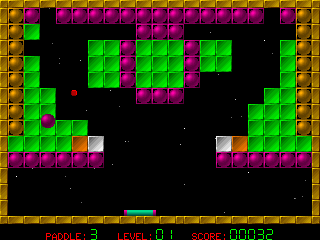
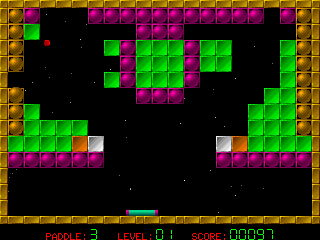
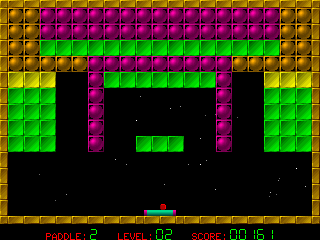
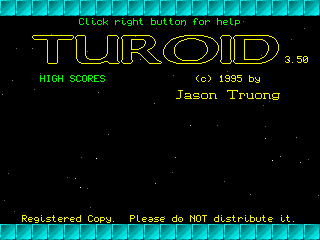
Turoid, released in 1994, is a fascinating "indie" relic of the DOS shareware era. Developed by Jason Truong, it is a high-octane brick-breaker that takes the classic
Arkanoid formula and injects it with boss fights and a much faster pace.
If you played this back in the day, you likely remember it for being significantly more aggressive and "darker" than your average Breakout clone.
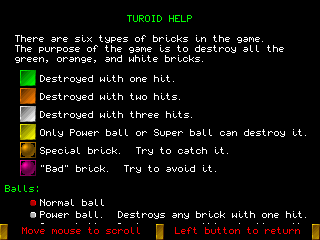
At its core, the goal is familiar: control a paddle at the bottom of the screen, bounce a ball, and clear the field of bricks. However, Jason Truong added several layers that
made Turoid stand out:
- The Combat Focus: Unlike early brick-breakers that were purely about geometry, Turoid feels like a combat game. There are moving enemies (often floating heads or geometric creatures) that fly around the screen, deflecting your ball and generally causing chaos.
- The "Boss" Mechanic: The game is named after the central antagonist—a giant, floating cybernetic head. You don't just clear levels; you are actively working your way toward a confrontation with this entity.
- Power-Up Overload: The game features the classic "capsule" drops. You can get lasers to shoot bricks directly, catch-paddles to hold the ball, and multi-ball power-ups that turn the screen into a chaotic mess of bouncing pixels.
It uses 256-color VGA graphics. The art style is very "mid-90s PC shareware"—lots of metallic textures, dark backgrounds, and hand-drawn sprites that look like they came straight out of a hobbyist's sketchbook.
If you had a SoundBlaster card, the game featured punchy sound effects for the lasers and explosions, which added to the "arcade" feel.
Turoid was part of a specific wave of games where solo developers were trying to out-do the arcade giants. Jason Truong managed to make the ball physics feel "tight" and responsive, which was the make-or-break factor for this genre. It wasn't as polished as
Krypton Egg (a famous French competitor), but it had a certain "garage-dev" charm that made it a staple on "300 Games in 1" CD-ROMs.
Discover your next favourite game.
Follow Free Game Empire for weekly classics, gameplay tips and community picks.
 Follow on Facebook



Comments