Baal
Developed by:
Smithson Computing
Also Known As
Smithson Computing (from 1982 to 1989)
Multiplayer:
No Multiplayer
Platform:
Rated:
4 x
Current rating:
Your rating:
Not rated -
login
- and rate
Uploaded by:
Anonymous
External links:
Description
Baal, released in 1989 for DOS (and 1988 for Amiga/Atari ST), is a quintessential "Psygnosis" game. While published by the legendary Psygnosis (famous for their owl logo and high difficulty),
it was indeed developed by Smithson Computing (led by Tim Smith). If you played this back in the day, you likely remember it for two things: its dark, sci-fi/horror atmosphere and its
punishing, "pixel-perfect" difficulty.
The Goal: A Descent into Hell
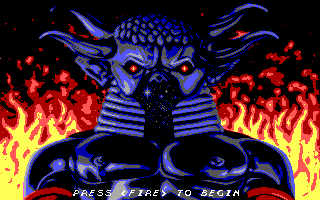
A demonic entity named Baal has stolen an advanced war machine (the "Warbird") and taken it down into his subterranean domain. You lead a squad of elite paratroopers into the underworld.
You must fight through four massive, trap-filled levels to recover the stolen pieces of the Warbird and eventually destroy Baal himself. Baal isn't a mindless "run and gun" game; it's a
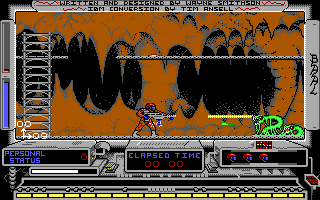
slow-paced, methodical action-platformer that demands memorization. Your character is armed with a laser rifle. Unlike many games of the era, you can’t just spray bullets. You have to time
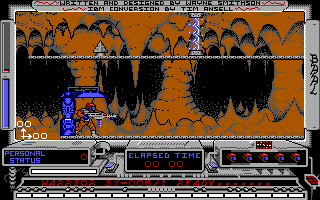
your shots to hit flying enemies and floor-based turrets. You have limited flight capabilities. This adds a vertical dimension to the levels, but managing your altitude while avoiding ceiling
traps is a major challenge. The levels are non-linear. You’ll spend a lot of time finding switches to deactivate force fields or opening teleporters to reach new sections of the cavern. In true
Psygnosis fashion, the game is brutally hard. There are "instant death" traps everywhere—spikes, mines, and enemies that spawn in tricky locations. One wrong pixel of movement often means
losing a life. The DOS version uses 16-color EGA graphics. While it lacks the lush color palette of the Amiga original, the artwork is still very detailed. It has a "gritty," metallic look
that makes the alien/hellish environment feel oppressive. For 1989, the game featured impressively smooth scrolling and large, complex maps that didn't require frequent loading screens.
Discover your next favourite game.
Follow Free Game Empire for weekly classics, gameplay tips and community picks.
 Follow on Facebook



Comments